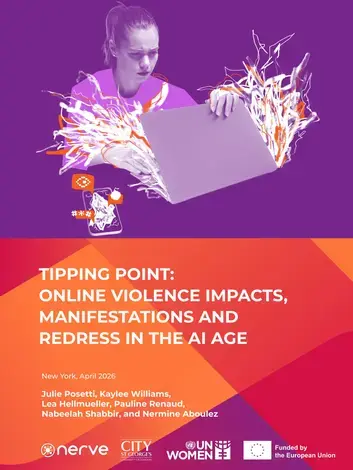
This publication examines how AI-enabled online violence is escalating harm against women in public life. Drawing on global survey data, it highlights mental health impacts, growing self-censorship, limited redress, and the urgent need for stronger accountability, protection, and legal responses. More
1 - 20 of 962 Results

Date:
This evaluation looks at how UN Women supported intergovernmental processes in major international decision-making forums from 2022 to 2025. It highlights what worked, where challenges remain, and how UN Women helped advance gender equality through advice, evidence, partnerships and inclusive dialogue. The findings offer practical insights to strengthen future engagement in intergovernmental processes and sustain progress on women’s rights.
Date:
This brief outlines the global context framing the justice gap across the life-course; barriers preventing adolescent girls and older women from accessing justice, including shared and age-specific dimensions; and policy and programme recommendations to build more inclusive, responsive, and accountable justice systems.
Date:
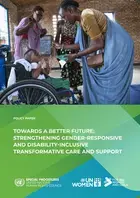
This policy paper provides key insights into the intersection of gender and disability within care and support environments. It emphasizes that developing comprehensive and inclusive care systems is essential for promoting gender equality and protecting the rights of both care recipients and caregivers, especially persons with disabilities.
Date:
This publication examines how AI-enabled online violence is escalating harm against women in public life. Drawing on global survey data, it highlights mental health impacts, growing self-censorship, limited redress, and the urgent need for stronger accountability, protection, and legal responses.
Date:
Extreme heat is a growing climate risk and a driver of gender- and age-based inequality, affecting health, labour, and social justice. Heat impacts arise from biological differences, social norms, and gendered roles. Women face heightened risks in pregnancy, informal and unpaid work; men face acute injury in outdoor labour. Vulnerability varies across the life course. Addressing heat requires age- and gender-responsive adaptation across policy systems.
Date:
This brief highlights how the war in Gaza has deeply affected women and girls, from rising deaths and injuries to hunger, displacement, and loss of healthcare and education. It calls for urgent action to protect civilians and ensure aid reaches those most at risk.
Date:
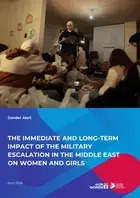
This gender alert highlights how escalating conflict in the Middle East is affecting women and girls. It shows the urgent risks to their safety, health, livelihoods, and rights, and calls for stronger action to ensure their protection, inclusion, and access to essential services during crisis and recovery.
Date:
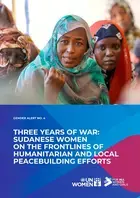
This gender alert analyses the disproportionate impact of the war on Sudanese women and girls and highlights the critical leadership role of Sudanese women in delivering humanitarian assistance and advancing local peacebuilding and mediation efforts amid the worst humanitarian and displacement crisis in the world.
Date:
Care is vital for people, communities, economies, and ecosystems, yet global care systems face gaps and inequalities. This publication gives policymakers a tool to analyze paid care coverage gaps, estimate the costs to close them, and assess the social and economic returns of increased public investment in care services.

Date:
This report examines how online misogyny and harmful masculine norms drive technology-facilitated violence against women and girls. It explores perpetration, digital culture, and prevention, and offers practical guidance for engaging men and boys, strengthening accountability, and building safer digital spaces for all.
Date:
This brief summarizes the findings of UN Women’s review of the overall understanding and integration of gender in UN counter-terrorism mechanisms. The review aims to inform UN Women’s revised engagement framework on counter-terrorism and prevention of violent extremism to update its strategic priorities in supporting the implementation of women, peace, and security commitments as part of the UN counter-terrorism agenda.
Date:
This research brief tracks what Member States report doing to strengthen access to justice to prevent and respond to violence against women and girls. It highlights global progress, good practices, persistent gaps, and the need for survivor-centred laws, services, and coordinated systems that work in practice.
Date:
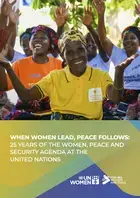
Over the last 25 years, UN Women, its predecessor organizations, and partners have been instrumental in moving the women, peace, and security agenda forward. This timeline spotlights key achievements across different contexts and with the hard work and dedication of our women civil society, United Nations, and Member State partners.

Date:
This report seeks to demonstrate the value of gender-inclusive digital public infrastructure (DPI) and its potential to accelerate progress towards the Sustainable Development Goals. However, DPI will do so only if it is designed and implemented to serve all people equitably and protect their rights.
Date:
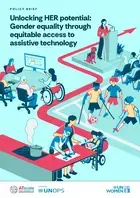
Despite the transformative potential of assistive technology, access to assistive technology remains deeply unequal and persistently gendered. This policy paper examines how gender inequities are embedded across five interconnected dimensions of assistive technology systems and provides recommendations for national governments, international organizations, and other stakeholders.
Date:
This guide provides practical guidance for Security Council Member States to anticipate, mitigate, and respond to risks of intimidation and reprisals against women civil society representatives briefing the Council. It offers strategies for risk-informed preparation, protective diplomatic practice, and follow-up, helping ensure women’s voices continue to inform the Council’s work on peace and security.
Date:
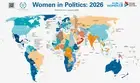
The “Women in politics: 2026” map shows persistent male dominance in political power. As of 1 January 2026, women lead only 28 countries, hold 27.4 per cent of parliamentary seats, and hold 22.4 per cent of cabinet posts, marking regression.
Date:
As progress on gender equality slows amid intensifying global needs, the 2026 Generation Equality Financial Commitments Analysis investigates the initiative’s financing dimension. It covers USD 50.3 billion in pledges and more than USD 21 billion in expenditures, assessing feminist financing models and alignment with global frameworks.
Date:
This framework outlines UN Women’s strategy to address discriminatory social norms through research-informed pathways: shifting narratives, improving material conditions for women and girls, and strengthening countervailing power via women’s organizations and broad coalitions. It guides implementation, enhances reporting on social norms change, and supports global dialogue, partnerships and joint action.
Date:
This publication examines women’s participation and leadership in international justice institutions. Drawing on interviews with women judges and experts, it highlights barriers to equal representation and documents women’s contributions to advancing international law, institutional change, and gender justice. It underscores why gender parity is essential to strengthening the legitimacy and effectiveness of international justice.