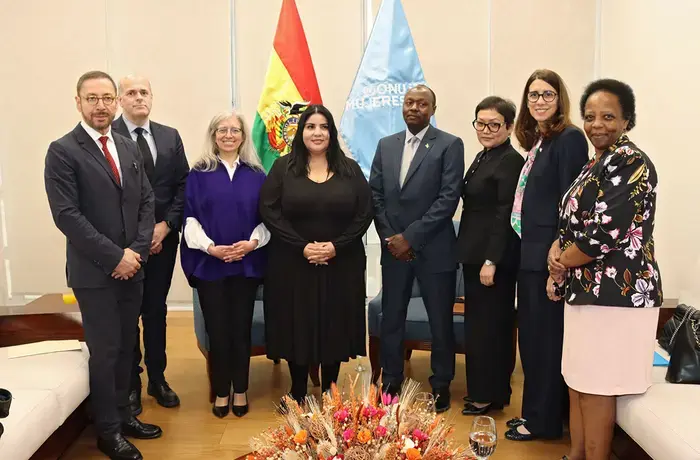
Gender stereotypes remain a barrier to women’s access to justice
CSW70 event calls for dismantling stereotypes and carving pathways for progress.
UN Women, in partnership with OHCHR, the CEDAW Committee, the Permanent Mission of Andorra, and the Permanent Mission of Switzerland, convened a side event on the margins of CSW70, entitled, “Access to justice and gender stereotyping: The contribution of CEDAW.”
“Justice fails when stereotypes enter the justice system”, said Federal Councillor Elisabeth Baume-Schneider, Head of Switzerland’s Federal Department of Home Affairs.

“By dismantling stereotypes. . . we move closer to justice systems that are truly fair, impartial and accessible to all”, said Chair of the CEDAW Committee Nahla Haidar.
UN Women Deputy Director Nyaradzayi Gumbonzvanda welcomed the CEDAW Committee’s forthcoming General Recommendation 41 on Gender Stereotypes, and announced the publication of UN Women’s framework for social transformation, “Ideologies, Institutions and Power: Addressing Discriminatory Social Norms.”
The framework positions changing social norms as a question of power, institutional transformation and ideological contestation – providing a new strategic foundation for advancing gender equality worldwide.

It proposes three pathways for progress:
- transforming narratives through the development of egalitarian narratives and building whole-of-society consensus
- changing material conditions through tangible changes in the lived realities of women, girls and other marginalized groups
- strengthening countervailing power through empowering feminist movements and building coalitions with diverse movements and actors.
Members of the CEDAW Committee shared their expertise regarding General Recommendation 33 on Women’s Access to Justice, and the latest developments relating to General Recommendation 41 on Gender Stereotypes – noting that formal equality before the law is insufficient.
“The reality remains that women’s access to these laws – and the effective implementation of these protections – remain deeply uneven because the barriers to justice are not merely legal. They are structural, social and cultural”, said Bandana Rana, Member of the CEDAW Committee and Co-Chair of the Committee Working Group on gender stereotypes.

Justice systems must actively address the structural conditions that prevent women from effectively claiming their rights, including training and capacity-building for judges, prosecutors, police officers, and other justice actors in all justice systems.
“When judicial actors rely on gender stereotypes in their work, this must be recognized as discrimination and a violation of women’s rights”, said Patsilí Toledo, Member of the CEDAW Committee. “Effective complaints procedures and oversight mechanisms are therefore essential.”
“Combating [gender stereotypes] is not a secondary issue”, said Secretary of State for Equality and Citizen Participation of Andorra, Mariona Cadena. “It is a democratic imperative and a responsibility of the State.”
The 70th session of the Commission on the Status of Women (CSW70)
CSW70, taking place from 9 to 19 March at the UN Headquarters in New York, is the UN’s largest annual convening on gender equality and women’s rights.