G77 and Emerging Partners Ministerial Roundtable highlights pathways to accelerate sustainable financing for gender equality
At the Commission on the Status of Women 70th Session (CSW70), global leaders gathered for the G77 and Emerging Partners Ministerial Roundtable to explore pathways for accelerating sustainable financing for gender equality for all women and girls.
Opening the event, Ms. Kirsi Madi, Deputy Executive Director of UN Women, highlighted the transformative potential of closing gender gaps in digital and financial systems.
“Closing the gender digital gap could unlock as much as US$1.5 trillion in global GDP and it could lift 30 million women out of poverty. Our challenge goes beyond identifying resources; it is instead about financial architecture itself. The architect needs to place gender equality at its heart.”

Held on 9 March 2026, the roundtable built on the success of the first G77 Ministerial Round Table convened during the Commission on the Status of Women 69th Session. The event was co-hosted by the governments of Brazil, Kazakhstan, Maldives, Timor-Leste and Uruguay in partnership with UN Women.
Discussions focused on advancing practical, system-level pathways to operationalize global commitments on financing for development through gender-responsive sustainable finance. Through its Sustainable Finance Programme, UN Women continues to convene partners and shape the global agenda on gender-responsive financial systems.
The roundtable featured two panel discussions bringing together ministers, policymakers and practitioners from across the financing ecosystem.
The first panel, a Ministerial Leadership Dialogue titled “Political Commitments to Action: Advancing Gender-Responsive Sustainable Finance,” highlighted national perspectives from the co-hosting countries. Moderated by Ms. Megan Gilgan, Director a.i., Strategic Partnerships Division at UN Women, the session emphasized the importance of partnerships between governments, development institutions and financial actors to translate commitments into action.
H.E. Ms. Elvina Sousa Carvalho, State Secretary for Equality of Timor-Leste, highlighted the importance of innovative partnerships.

Accelerating sustainable financing requires innovative financing mechanisms, in partnership with private sector and civil society, to advance the inclusive economic empowerment of women.
Similarly, H.E. Ms. Márcia Lopes, Minister of Women of Brazil, emphasized the importance of adequate funding for gender equality policies.

There is no public policy without appropriate funding, as required by the Brazilian Constitution.
The representative from Kazakhstan, H.E. Ms. Elvira Azimova, Chairperson of the Constitutional Court, reaffirmed the Court’s commitment to cooperation with international partners, expressing their “Readiness to continue active cooperation with all Member States, United Nations system entities, and international partners to advance this crucial global agenda.”
Meanwhile, Uruguay’s speaker Ms. Noelia Martinez, Deputy Director General of Political Affairs, Ministry of Foreign Affairs, underscored the role of political leadership in advancing equality.
“Gender equality is a matter of power but also a choice. Financing for gender equality isn’t a challenge today but is a choice as well.”
It was important to have Uruguay represented in the panel as the G77 Chair for this year.
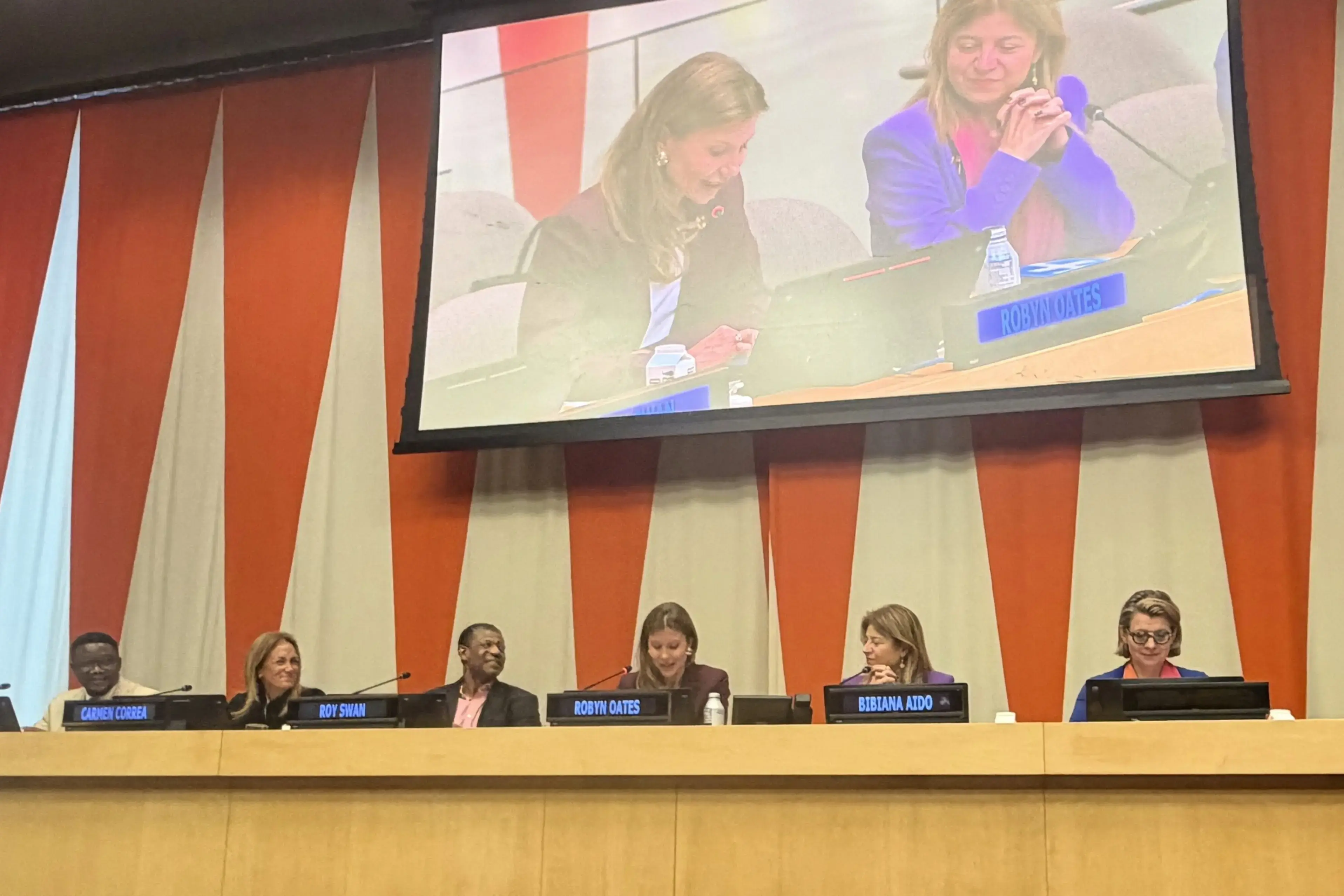
The second panel, “Strengthening Financial Systems for Gender Equality: From Policy Frameworks to Instruments at Scale,” explored how financial systems can better support gender equality through innovative instruments and policy frameworks. Moderated by Ms. Robyn Oates, Head of Sustainable Finance at UN Women, the discussion included perspectives from the Ford Foundation, Pro Mujer and the Government of Rwanda.
Participants also shared national initiatives supporting women entrepreneurs. H.E. Mr. Ali Naseer Mohamed, Permanent Representative of the Maldives to the United Nations, highlighted a government initiative supporting women-led businesses.
“In 2024, The Maldives Government launched an initiative allocating US$ 6.47 million for start-up loans to women entrepreneurs, with 25% earmarked for women with disabilities. Over 16% of the funds have been disbursed over the past 2 years.”


-
Image
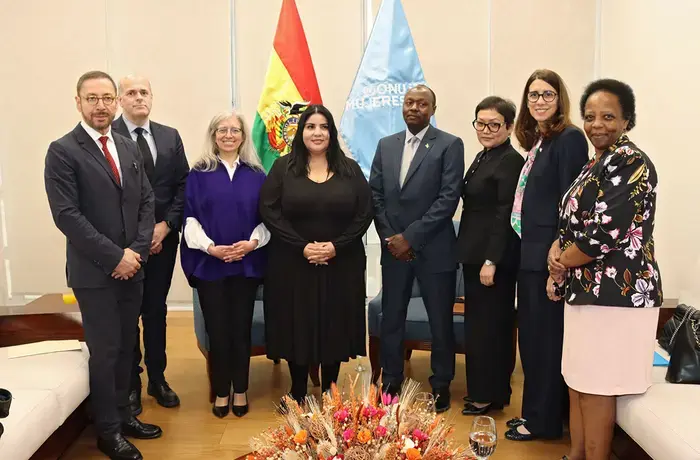
Left to right: Ms. Noelia Martinez, H.E. Mr. Ali Naseer Mohamed, H.E. Ms. Márcia Lopes, Ms. Megan Gilgan, H.E. Ms. Elvira Azimova, Ms. Bibiana Aído, Ms. Robyn Oates, Ms. Carmen Correa, H.E. Ms. Elvina Sousa Carvalho. 9 March 2026. Photo: UN Women/Radhika Chalasani -
Image
Left to right: Mr. Ngayaboshya Silas (Director General, Ministry of Gender and Family Promotion, Government of Rwanda), Ms. Carmen Correa, Mr. Roy Swan, Ms. Robyn Oates, Ms. Bibiana Aído (Regional Director of UN Women for the Americas and the Caribbean), Ms. Megan Gilgan. 9 March 2026. Photo: UN Women/Queenee Choudhury -
Image
Left to right: H.E. Mr. Ali Naseer Mohamed, Ms. Bibiana Aído. Photo: UN Women/Radhika Chalasani
Representatives from civil society and financial institutions also highlighted innovative financial tools supporting women entrepreneurs. Ms. Carmen Correa of Pro Mujer emphasized that “Financial innovation is very powerful, but it cannot work on its own.” She noted that Pro Mujer issued two gender bonds and became the first non-traditional issuer of gender bonds in Latin America.
Mr. Roy Swan of the Ford Foundation emphasized the need to address systemic barriers limiting women’s access to capital. He stated “Volumes of research document the power of capital in women’s hands. For example, studies show that women-led startups consistently outperform on capital efficiency, delivering a significantly higher revenue return per dollar of funding than male-led startups. However, investment flows continue to ignore this reality, leaving women with only a fraction of total capital. So, what does this mean? It means it's not just the data. The higher hurdles are the psychology and ‘-isms’. This is an important reality that we must confront head-on.”
As the global community accelerates efforts to achieve the Sustainable Development Goals, UN Women remains committed to advancing gender-responsive sustainable finance as a cornerstone of inclusive and resilient economies. By strengthening standards, mobilizing capital, and fostering innovation in financial instruments, UN Women is working to ensure that gender equality is embedded at the heart of sustainable finance and that the resources needed to achieve it are mobilized at the scale and speed required.
The 70th session of the Commission on the Status of Women (CSW70)
CSW70, taking place from 9 to 19 March at the UN Headquarters in New York, is the UN’s largest annual convening on gender equality and women’s rights.