Advancing justice in every context: CSW70 event spotlights women’s access to justice in conflicts
High-level event spotlights international cooperation to bridge the justice gap, including the UNDP-UN Women Gender Justice Platform.
A high-level event at the 70th Session of the Commission on the Status of Women (CSW70) brought together decision-makers and world leaders to advance women’s access to justice – particularly in fragile and conflict-affected contexts – and to identify concrete actions for strengthening gender-responsive justice systems.
The event, Advancing Women’s Access to Justice: Building Justice Systems that Deliver for All Including in Fragile Contexts – organized by UNDP and UN Women, with the governments of Brazil, the Kingdom of the Netherlands and Ukraine – spotlighted international cooperation to bridge the justice gap, including through the UNDP-UN Women Gender Justice Platform.

Centring women and girls
“Justice reforms must begin with women and girls – and with their needs and priorities”, said UN Women Executive Director Sima Bahous. “It means restoring identity documents; protecting land rights and children’s safety; and creating spaces where women can speak safely and have their rights enforced.”
Bahous also shared UN Women’s new publication, Advancing gender equality through legislative reform in transitional justice contexts, which shows that legal change “only delivers when women’s movements, political will and sustained financing come together to turn reforms into real protection”, she added. “Women are not only demanding justice – they are designing it.”
Bridging the justice gap: UNDP-UN Women Gender Justice Platform
In conflict-affected settings, the justice gap is stark: More than 60 percent of women report unmet legal needs. Today, more than 676 million women live within 50 kilometers of deadly conflict – the highest number ever recorded.

UNDP Administrator Alexander De Croo emphasized the urgency of closing this gap: “Justice cannot wait.” In conflict and crisis-affected contexts, he said, “too often, justice for women is treated as something that comes later – after security, after stabilization, after recovery. But delaying justice does not create stability. It entrenches inequity. And fuels impunity.”
UN Women and UNDP are working together to address this justice gap. In 2024, the UNDP-UN Women Gender Justice Platform supported 79,477 women and girls in accessing justice services through formal and informal mechanisms. Of these, 76,423 received legal information and awareness through mobile courts, legal clinics and other innovative approaches. The Platform now supports justice and security reforms in more than 40 countries.

Working together – and sustaining momentum
Peter Derrek Hof, Ambassador for Women’s Rights and Gender Equality for the Netherlands, called for justice systems to “deliver services that address women’s needs and demands in a direct, tangible and visible way.” He reiterated his country’s commitment to “support partners who put women’s justice needs at the centre of reform.”
Márcia Lopes, Minister of Women for Brazil, shared her country’s experience enhancing women’s access to justice: “Justice needs to be built with women – listening to survivors, feminist organizations and the community.”
Raquel Lagunas, Director of Gender Equality at UNDP, who moderated the event, began her remarks with a powerful frame: “Justice begins where silence ends.”
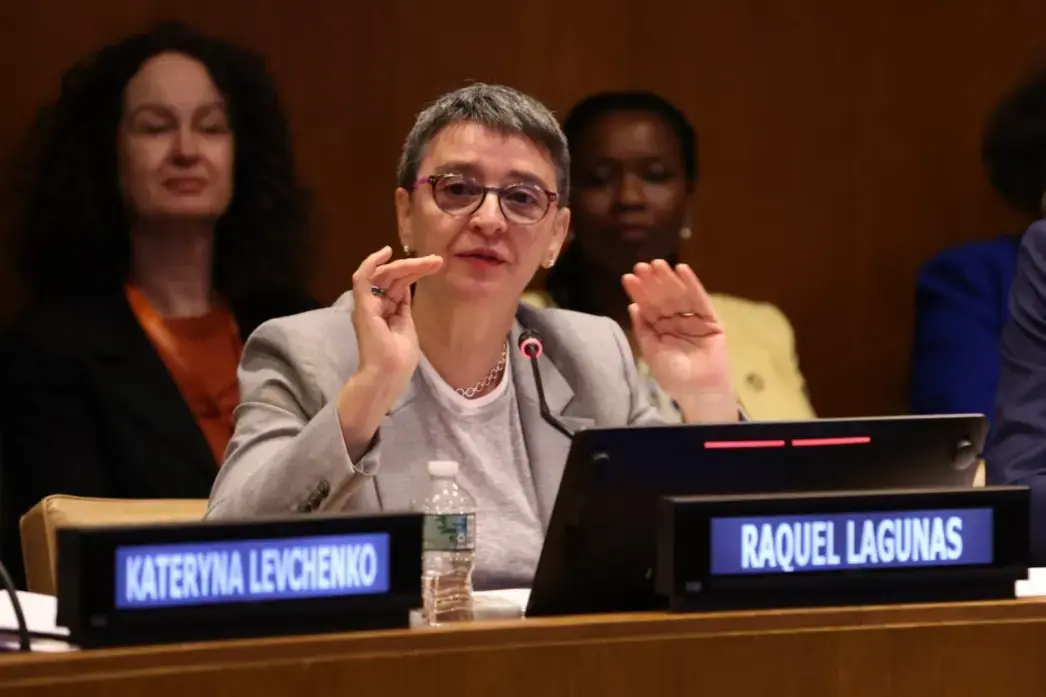
Justice begins where silence ends. When women’s voices change the laws and its institutions, justice becomes not only possible – but transformative.
The discussion continued on innovative approaches to justice reform, as Lagunas directed questions to each panelist.
Kateryna Levchenko, Commissioner for Gender Equality Policy for Ukraine, explained how her government had worked to strengthen and restore trust in the justice system after the 2022 full-scale invasion. This includes the ratification of the Rome Statute of the International Criminal Court and the Istanbul Convention on violence against women, and the signing of a Framework of Cooperation with the United Nations on Conflict-Related Sexual Violence. These measures were important “not only for the delivery of justice but also for social cohesion and democratic legitimacy”, she reflected.

Amrita Kapur, Secretary-General of the Women’s International League for Peace and Freedom (WILPF), highlighted the importance of feminist peacebuilding: “We need sustained support for feminist movements. Women are at the frontline. This is where the transformative potential is most urgent, and yet it is where there is the least support.”
Tea Trumbic, Women, Business and the Law Manager at the World Bank Group, addressed the structural dimensions of the justice gap: “Women enjoy less than two-thirds of the legal rights of men globally. Even where laws guaranteeing equal rights for women exist, only about half the policies needed to support their implementation are in place.” In fragile and conflict-affected countries, she noted, the gap is even wider: “Women have fewer rights on paper, fewer systems to support those rights, and limited ability to enforce them”, she said. “To ensure women’s rights hold under pressure, we must invest not only in legal reform, but institutions, enforcement and access to justice.”


-
Image
UN Assistant Secretary-General Michelle Muschett. Photo: UNDP/Fouad Juez -
Image
Minister of Women for Brazil Márcia Lopes. Photo: UNDP/Fouad Juez -
Image
The high-level CSW70 event brought together global decision-makers. Photo: UNDP/Fouad Juez -
Image
UNDP Administrator Alexander De Croo. Photo: UNDP/Fouad Juez
A clear message
“The gender justice gap is a systemic crisis. It affects women in a disproportionate manner, but it affects the whole world – all of society”, said Michelle Muschett, UN Assistant Secretary-General, Assistant Administrator and Director of the Regional Bureau for Latin America and the Caribbean.
“But [positive] transformation is already happening,” she added in her closing remarks. “We need to pay attention to scaling what’s working – with special consideration for conflict-affected regions and countries. We need to place people at the centre of all these reforms ... and advance reforms with a gender-responsive lens. And we need to support women’s leadership – because this conversation isn’t just about women and girls’ access to justice, but about how the participation of women in public life can be transformative in itself.”
“Gender equality is not just an objective itself – but is a clear accelerator of all dimensions of development”, closed Muschett.
The event’s message was unambiguous: Women are not waiting to be given justice – they are building it. The task now is to ensure that the systems, resources and political will are in place to meet them there.